



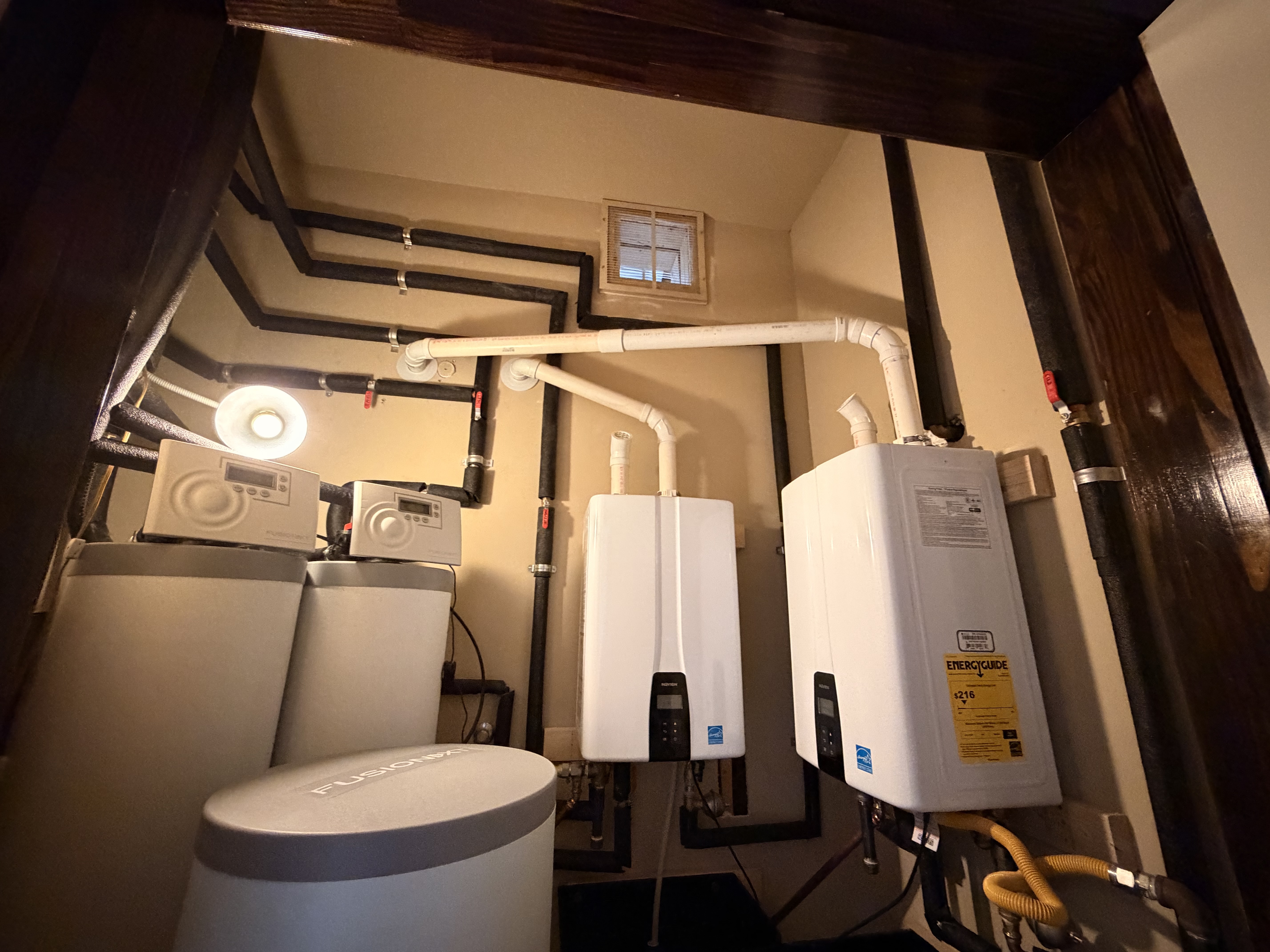
A tankless water heater can be a great upgrade for an Austin home, especially if you regularly run out of hot water or want to free up space. But a tank can still be the better investment when it meets your household’s needs and costs less to replace. The right choice depends on your existing setup, hot water usage, budget, and maintenance plans.
Here’s how the options compare, including how local water conditions affect maintenance and long-term costs. Most of the tankless discussion below focuses on gas models. If your home is all-electric, conventional electric tanks and heat pump water heaters deserve a separate comparison.
Continuous Hot Water vs Stored Hot Water
A tank water heater stores a supply of hot water and reheats it as you use it. If your household uses hot water faster than the heater can recover, showers can start turning lukewarm. How quickly it recovers depends on the tank’s size, fuel source, heating capacity, and incoming water temperature.
A properly sized tankless unit heats water as it flows, so it can keep supplying hot water for back-to-back showers without waiting for a storage tank to recover.
Continuous hot water does have a limit: how much the unit can heat at one time. Multiple showers and appliances running together can exceed that capacity, leading to reduced flow or temperature changes, depending on the unit.
That’s why we size a tankless system around the fixtures you use together and the temperature rise needed during colder weather, rather than relying only on the maximum flow rate advertised on the box.
Lifespan
Tankless water heaters generally have a longer expected service life than conventional tanks. A tank might last around 8 to 12 years, while a maintained tankless unit may last 15 to 20 years or longer. These are planning estimates, not guarantees. Water quality, installation, usage, and maintenance all affect the outcome.
That longer potential lifespan can help offset the higher purchase price, but it isn’t the whole calculation. Maintenance and repairs also belong in the comparison. A tankless unit lasting 20 years does not mean 20 years without additional costs.
Energy Use
A conventional tank loses some heat while storing hot water, so it cycles on periodically to maintain its temperature even when you aren’t using it.
Gas tankless water heaters largely avoid those storage losses, and high-efficiency condensing models can use less energy than conventional gas tanks. Your actual savings depend on the equipment being replaced, how much hot water you use, utility rates, and features such as recirculation.
We wouldn’t recommend converting based on energy savings alone. Comfort, available space, installation cost, and maintenance matter too.
For an all-electric home, a heat pump water heater is also worth considering. It stores hot water in a tank but uses substantially less electricity than a conventional electric resistance heater.
Space
A tankless water heater mounts on a wall and usually takes up much less room than a storage tank. Depending on the location, that can free up useful floor space or make an equipment area less crowded. The installation still needs proper clearances and room for future service.
Replacing an attic tank also removes a large reservoir of stored water from above your ceiling. That’s a meaningful benefit, but it does not eliminate leak risk. A tankless unit and its connected piping can still leak, so proper drainage and leak protection remain important.
If getting the water heater out of the attic is your goal, we can also evaluate whether relocating it makes sense for your home.
Upfront Cost
Replacing a tank with a similar tank is usually less expensive than converting to tankless for the first time.
A gas tankless conversion may involve changes to the gas supply, new venting, electrical power, and condensate drainage for a condensing model. Whether the gas line needs upgrading depends on the unit and the capacity of the existing system.
Replacing an existing tankless unit can cost less than a first-time conversion, although compatibility and installation corrections can still affect the price.
At PlumbAZING, we look at the existing setup before recommending an option. That includes gas capacity, venting routes, drainage, service access, and how your household uses hot water. We’ll explain what each option requires and provide pricing for your home.
Our full breakdown of water heater replacement cost in Austin explains the other factors that affect installation pricing.
The Austin Hard Water Factor
This is the part you need to hear before you buy.
Water hardness matters when choosing and maintaining a water heater. Mineral levels vary across Austin-area water providers and individual homes, especially when a water softener or other treatment system is involved.
As water heats, minerals can form deposits. In a tank, sediment and scale can collect inside the heater. In a tankless system, scale can build up in the heat exchanger and affect heat transfer and water flow.
We recommend annual tankless maintenance, with descaling frequency based on the manufacturer’s guidance, water conditions, temperature settings, and usage. Some homes may need more frequent descaling. Maintenance also includes checks beyond flushing the heat exchanger.
Regular service helps control buildup and maintain performance, but it cannot guarantee that scale-related problems will never occur. Damage related to water quality or neglected maintenance may also fall outside the manufacturer’s warranty coverage.
Tank water heaters need maintenance too. Whichever system you choose, include ongoing care in the cost of ownership.
When a Tank Is Still the Better Choice
We install both, and there are plenty of situations where replacing a tank makes sense:
- Your current tank meets your household’s hot water needs.
- You want a lower upfront installation cost.
- Converting would require substantial gas, venting, or electrical work.
- You plan to move soon and may not get enough use from the upgrade to justify the added cost.
- You prefer a conventional system while still planning for its recommended maintenance.
When Tankless Is Worth Considering in Austin
Tankless may be a good fit when:
- You regularly run out of hot water during back-to-back showers.
- You plan to stay in the home and value the comfort benefits over time.
- Your home has a suitable gas supply, or upgrading it is practical.
- You want to reclaim space occupied by a storage tank.
- You want to remove a large storage tank from the attic while keeping appropriate leak protection.
- You’re comfortable budgeting for routine maintenance and potential repairs.
A larger household can benefit from continuous hot water, but the system still needs enough capacity for the fixtures used at the same time.
When Tankless Is Worth It in Austin
- You're staying in the home long term
- You have a bigger household and run out of hot water
- Your water heater is in the attic and you want that risk gone
- You want the space back
- You'll keep up with yearly maintenance
Talk to an Austin Plumber Who Installs Both
We’re Josh and Alan, the owners and hands-on plumbers behind PlumbAZING. We install and service both tank and tankless water heaters, and our recommendation starts with your home and how you use hot water.
We’ll look at your setup, explain what a conversion would involve, and help you compare it with replacing your existing tank. You’ll get clear pricing and a chance to ask questions before deciding.
We serve Austin, Round Rock, Cedar Park, Pflugerville, Georgetown, Buda, Kyle, and Lakeway.
Call or text (512) 888-4406 or request service online. New customers get $50 off their first service.
Frequently Asked Questions
Is a tankless water heater worth it in Austin?
It can be, especially if you regularly run out of hot water, want more space, and plan to stay in your home. The value depends on conversion costs, your existing fuel source, household demand, and maintenance. A tank remains a good option for many homes.
How much does a tankless water heater cost in Austin?
The price depends on whether you’re replacing an existing tankless unit or converting from a tank. Gas supply changes, venting, condensate drainage, installation location, and equipment selection all affect the total. An on-site evaluation helps establish an accurate price.
How long does a tankless water heater last?
A tankless water heater may last 15 to 20 years or longer with proper installation and maintenance. Actual service life varies with water quality, usage, and equipment condition, and repairs may be needed along the way.
Does hard water hurt a tankless water heater?
Hard water can leave mineral scale in the heat exchanger, affecting performance and potentially causing damage. Regular maintenance and descaling help manage that buildup. The appropriate schedule depends on water conditions, usage, and manufacturer guidance.
Can a tankless water heater run multiple showers at once?
Yes, when it has enough capacity for the combined demand. Proper sizing considers how many fixtures run together and how much the incoming water needs to be heated, particularly during colder weather.
Does tankless mean instant hot water at the faucet?
No. Water already sitting in the pipes still has to travel out before newly heated water reaches the fixture. A properly designed recirculation system can reduce that wait, but switching to tankless alone does not guarantee faster delivery.