



If you live in Austin, a water softener isn't just about getting rid of spots on your shower glass.
The water entering your home affects virtually every part of your plumbing system — your water heater, faucets, shower valves, appliances, piping and more. Austin's water contains hardness minerals that create scale, while the municipal water supply also uses chloramines for disinfection.
A water softener and carbon filter address two very different parts of that equation.
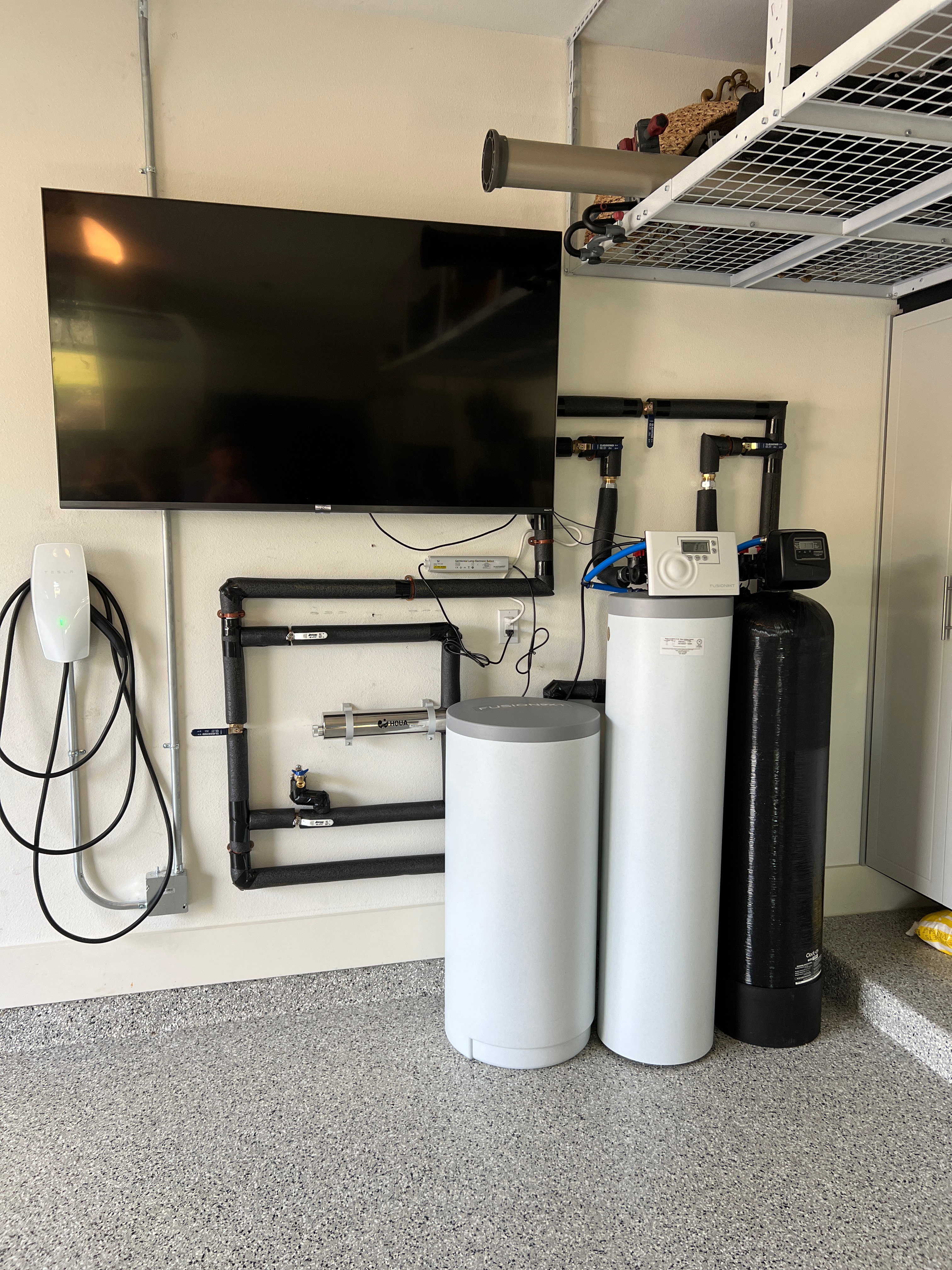
That's why at PlumbAZING, we recommend a properly sized salt-based water softener paired with whole-home carbon filtration for Austin homes. The softener removes hardness minerals, while the carbon filtration is designed to reduce chloramines and other targeted contaminants before that water is distributed throughout the home.
Done correctly, whole-home water treatment isn't just about better-feeling water. It's about protecting your plumbing system, protecting the equipment you've invested in and reducing your family's exposure to substances you may not want in the water you use every day.
Here's what each system actually does, why we recommend using them together and why proper water treatment can actually save you money over time.
Why Austin Water Needs Treatment
Austin's water contains dissolved calcium and magnesium — the minerals responsible for hard water. As that water moves through your plumbing and is repeatedly heated, those minerals can leave scale behind.
You've probably seen the obvious signs: white buildup on faucets and showerheads, cloudy glassware, spots on shower doors and soap that doesn't lather as easily.
The buildup you can't see is more important.
Hard-water scale can accumulate inside water heaters, fixtures and water-using appliances. In a traditional tank water heater, mineral deposits can collect as the water is repeatedly heated. In a tankless water heater, scale can form inside the heat exchanger where efficient heat transfer is critical.
But hardness is only one part of the water-treatment conversation.
Austin Water also uses chloramines to disinfect the municipal water supply. Disinfection is necessary to control potentially dangerous microorganisms as water travels through the public distribution system, but a water softener isn't designed to remove chloramines or the disinfection byproducts that can be present in treated municipal water.
That's why we believe properly treating Austin water means addressing both hardness and filtration.
Signs Hard Water Is Costing You Money
Hard water doesn't always announce itself with a major plumbing failure. Most homeowners see the smaller symptoms first:
- White mineral buildup around faucets and showerheads
- Spots and film on dishes and glassware
- Scale on shower doors and tile
- Soap and shampoo that don't lather as effectively
- Mineral accumulation inside water heaters
- Scale buildup in faucets, cartridges and plumbing fixtures
- Reduced performance and potentially shortened life of water-heating equipment
Individually, these problems can seem minor. Across an entire home over years, they add up.
A properly designed water-treatment system addresses the water before it travels throughout the house instead of continually cleaning scale, servicing equipment and replacing components affected by it.
What a Water Softener Actually Does
A true water softener uses ion exchange to remove calcium and magnesium from the water.
As incoming water passes through the softener's resin, those hardness minerals are exchanged for sodium ions. The system periodically regenerates using salt from the brine tank, allowing the resin to continue removing hardness.
The key word is removes.
A properly sized salt-based softener removes the minerals responsible for hard-water scale before they travel through your water heater, fixtures and appliances.
That means less new scale forming throughout the plumbing system, better performance from soaps and detergents, less mineral spotting and less mineral buildup for your plumbing equipment to deal with.
For Austin-area water, salt-based ion-exchange softening is what PlumbAZING recommends when the goal is actually soft water.
What About Salt-Free Water Conditioners?
You'll see plenty of products advertised as "salt-free water softeners." That's a term homeowners should be careful with.
Salt-free conditioners do not actually soften water because they don't remove the calcium and magnesium responsible for hardness. Some systems are designed to alter how those minerals form deposits, but the hardness minerals remain in the water.
That's fundamentally different from ion-exchange softening.
For the water conditions we encounter in Austin and the surrounding area, PlumbAZING does not recommend salt-free conditioners as a substitute for a properly sized salt-based water softener.
If we're treating a home for hard water, we want to actually remove the hardness.
Why a Water Softener Alone Isn't Enough
A water softener does one job extremely well: it removes the calcium and magnesium responsible for hard water. But if you're investing in a quality softener, it also makes sense to protect it.
That's one of the biggest reasons we recommend pairing every properly sized softener with whole-home carbon filtration.
Chloramines and other disinfectants in municipal water can break down softener resin over time. When properly sized carbon filtration is installed ahead of the softener, it removes or reduces those contaminants before they reach the resin.
In our experience, that can roughly double the expected life of the softener resin — taking something that may last around 4–5 years under constant disinfectant exposure and extending it closer to 8–10 years when properly protected and maintained.
That's a major return from equipment that's already doing another important job for the home.
The carbon filtration treats the incoming water first, reducing chloramines and other targeted contaminants while protecting the softener behind it. The softener then removes the calcium and magnesium responsible for hardness and scale.
And because this happens where water enters the home, the benefits aren't limited to one drinking-water faucet.
You're filtering the water first. You're protecting the softener. You're removing the hardness. And you're sending treated water throughout the entire house.
That's why we call it water treatment — not just water softening.
Meeting a Regulatory Standard Isn't the Same as Removing It
Austin's municipal water meets current drinking-water regulatory standards. That's important, and we aren't suggesting otherwise.
But meeting a regulatory limit doesn't mean the water contains none of the substances being regulated.
Disinfecting municipal water is necessary for public health, but the process can also create disinfection byproducts such as trihalomethanes and haloacetic acids. These compounds are regulated because of health concerns associated with long-term exposure at elevated levels.
For homeowners who want to reduce their exposure to these substances, a water softener isn't the answer. Proper filtration is.
That's one of the reasons we believe whole-home carbon filtration is an important companion to a water softener in Austin. It provides another treatment stage before that water reaches the faucets, showers and fixtures your family uses every day.
The point is to understand what's in the water, understand what each treatment system actually removes, and give homeowners the ability to reduce substances they would rather not have traveling throughout their home.
Carbon Filtration Changes the Whole System
Carbon filtration does more than improve the water your family uses — it also protects the water softener itself.
Instead of filtering a small amount of drinking water through a refrigerator filter, you're treating the water where it enters the home. Properly sized carbon filtration reduces chloramines and other targeted contaminants before that water reaches your softener, water heater, faucets, showers and appliances.
That means better-tasting and better-smelling treated water is available throughout the house — including right from the kitchen faucet. For many homeowners, that makes the little refrigerator filter largely unnecessary as their primary source of filtered drinking water.
Then the softened side of the system takes over.
After filtration, the water passes through the salt-based softener, where calcium and magnesium are removed. Now you're addressing both sides of the problem: the carbon system reduces targeted contaminants and protects the softener resin, while the softener removes the hardness minerals responsible for scale.
The result is whole-home treated water that benefits both the family using it and the plumbing carrying it.
Your family gets filtered, softened water throughout the home. Your softener resin can last substantially longer. Your water heater, fixtures and appliances see less hardness-related scale. And your plumbing system isn't being continuously supplied with untreated hard water.
That's the difference between simply installing a water softener and installing a properly designed whole-home water-treatment system.
What a Softener Does for Your Water Heater
Your water heater is one of the biggest reasons we recommend a water softener in Austin.
Hard water doesn't just leave spots on your fixtures. Every time water is heated, calcium and magnesium can form mineral deposits. In a tank-style water heater, that buildup collects as sediment and scale inside the tank. In a tankless water heater, scale can build directly on the heat exchanger and restrict heat transfer.
Either way, your water heater has to work against buildup that simply doesn't need to be there.
A properly sized salt-based softener removes those hardness minerals before they ever reach the water heater. That means less scale, better heat transfer, less scale-related maintenance and better protection for one of the most expensive plumbing appliances in your home.
We see the effects of hard water on water heaters every week, which is why water treatment often comes up when we're replacing one. If you're already investing thousands of dollars in a new water heater, it makes sense to protect that investment instead of sending the same untreated hard water through the new one.
A water softener doesn't just manage the symptoms of hard water — it removes the minerals causing the problem before they reach your water heater.
Your Water Treatment Shouldn't Restrict Your Water
Water-treatment equipment should be sized to the home, not pulled off a shelf because the same system was installed next door.
At Plumbazing, we look at household demand, number of bathrooms, expected simultaneous water use, incoming water conditions and the flow requirements of the home before selecting equipment.
Flow rate matters.
You shouldn't invest in whole-home water treatment only to discover that your showers suffer whenever someone starts the washing machine.
That's why we use properly sized systems with full-port configurations designed to maintain the flow the home requires instead of unnecessarily choking down the main water supply.
Carbon filtration has to be sized correctly as well. Water needs adequate contact with the filtration media for effective treatment. A filter being capable of physically passing a certain number of gallons per minute doesn't automatically mean it's effectively treating the water at that same flow rate.
The goal is simple: effective treatment without sacrificing the water flow your home needs.
Water Softeners and Carbon Filters Aren't All Created Equal
Two water-treatment systems can look almost identical sitting in a garage and perform very differently.
Grain capacity is only one part of choosing a water softener. Service flow rate, control valve size, resin quality, pressure loss, regeneration efficiency, programming and long-term serviceability all matter.
Carbon filtration is no different. The type and quantity of filtration media matter, particularly when a system is being selected for chloramine reduction. The system also needs enough capacity and contact time to treat the water while keeping up with household demand.
That's why we don't believe in installing the same package in every house.
A properly designed system should be selected around the home's water conditions, plumbing and actual usage — not simply the number printed on the side of a tank.
Why We Stand Behind NuGen and Certiflow
At PlumbAZING, we primarily install NuGen and Certiflow water-treatment systems because they allow us to build the system around the home instead of forcing the home around the equipment.
We can properly size the softener and filtration components for household demand, select the appropriate treatment media, maintain strong flow through the system and program the equipment for the actual water conditions it's treating.
We also want equipment that can be serviced.
Water treatment isn't something that should be installed and forgotten forever. Control valves, resin and filtration media all have service and maintenance requirements over time. We prefer equipment with serviceable components and available replacement parts so the system can be maintained instead of automatically replaced when something eventually needs attention.
The brand matters, but correct sizing, setup and installation matter just as much.
A Water Softener Is One of the Few Appliances That Can Save You Money
Most appliances in your home cost money to own and operate. A properly sized water softener is different — it's one of the few pieces of equipment you can add to your home that can actually help reduce costs throughout the rest of the house.
Hard water costs money in ways that aren't always obvious.
Scale builds up inside water heaters and makes heat transfer less efficient. It accumulates inside faucets, shower cartridges and other plumbing fixtures. Dishwashers, washing machines, ice makers and other water-using appliances all have to operate with that same hard water every day.
Then there's everything you continually purchase because of hard water. Soft water allows soaps and detergents to work more effectively, meaning you can use less laundry detergent, dishwashing detergent, shampoo, body wash and household cleaners. You'll also spend less time and money fighting mineral deposits on fixtures, shower glass and other surfaces.
A properly sized salt-based softener attacks the source of those problems by removing the calcium and magnesium before they travel throughout the house.
Pair that softener with properly sized carbon filtration and you're also protecting the investment you made in the softener itself. By reducing chloramines and other disinfectants before they reach the resin, carbon filtration helps extend the useful life of the softener resin.
So you're not buying equipment simply to make the water feel nicer.
You're helping protect your water heater, plumbing fixtures and appliances, reducing soap and cleaning-product use, reducing scale-related maintenance, and extending the life of the water-treatment equipment itself.
Those savings happen throughout the home, year after year.
That's why we view a quality water softener and carbon filter differently from most household purchases. It's an investment designed to help protect everything downstream of it — and one that can pay you back through lower operating, maintenance and replacement costs over its life.
Is a Water Softener Worth It in Austin?
For most Austin-area homes on hard, chloraminated municipal water, our answer is simple: yes — and we recommend doing more than installing a softener by itself.
A properly designed water-treatment system can save money while protecting both your home and the water your family uses every day.
The salt-based softener removes the hardness minerals responsible for scale, helping protect your water heater, plumbing fixtures and water-using appliances while reducing soap, detergent and cleaning-product use.
The carbon filtration reduces chloramines and other targeted contaminants before they travel throughout the house. It also protects the softener resin itself, helping it last substantially longer when the system is properly sized and maintained.
And because both systems treat the water where it enters the home, those benefits aren't limited to a refrigerator dispenser or one drinking-water faucet.
You're treating the water for the entire house.
Better-tasting water. Less hardness and scale. Reduced exposure to targeted contaminants. Longer-lasting softener resin. Better protection for water heaters, fixtures and appliances. Less money spent fighting the effects of untreated hard water year after year.
That's why we don't consider a properly designed water softener and carbon filter an unnecessary luxury in Austin. It's an investment in the plumbing system, the equipment connected to it and the quality of the water your family uses every day.
Remove the hardness. Filter the water. Protect the equipment. Maintain the flow. And stop paying for the problems untreated water leaves behind.
Water Softener and Carbon Filter Installation in Austin
PlumbAZING installs and services whole-home water softeners and carbon filtration systems throughout Austin, Round Rock, Cedar Park, Pflugerville, Georgetown, Lakeway, Buda, Kyle and the surrounding Central Texas area.
We install NuGen and Certiflow systems sized around the home's water conditions and actual demand, with an emphasis on effective treatment without unnecessarily restricting household water flow.
If you're considering a water softener or whole-home carbon filtration system, we'll look at your existing plumbing, water supply and household needs and explain what makes sense for your home.
No salt-free substitute for a softener. No one-size-fits-all package. No oversized sales pitch.
Just properly selected water treatment designed for the home it's serving.
Call or text PlumbAZING at 512-888-4406 or request service online at Plumbazing.com.